
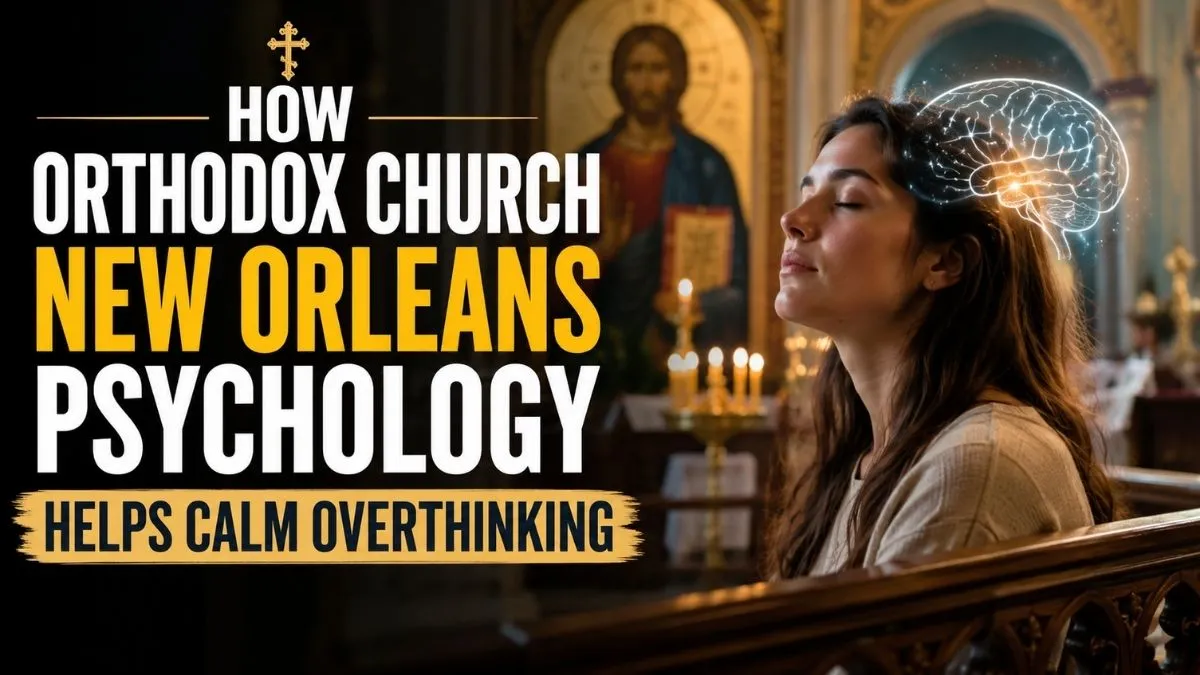
There are moments when the mind refuses to rest. A conversation replays endlessly. A future problem feels larger than life. Small worries become mental loops that drain energy, disturb sleep, and leave people emotionally exhausted. Many individuals struggling with overthinking search for practical solutions, yet they often overlook the connection between psychology, community, and spiritual support.
At StMarkNOLA, many people discover that mental wellness is not only about managing thoughts but also about finding meaning, connection, and emotional balance. The relationship between Orthodox Church New Orleans psychology, faith and mental health, and emotional resilience offers a perspective that feels surprisingly relevant to modern life.
Whether you’re dealing with stress, anxiety, loneliness, burnout, or mental fatigue, understanding how psychology and faith work together may provide a healthier path toward mental clarity and emotional health.
Why Overthinking Feels So Difficult to Escape
Most people assume overthinking is simply “thinking too much.” Psychology suggests something deeper.
Overthinking often develops when the brain believes constant analysis will prevent future pain or mistakes. The mind begins scanning for threats, replaying memories, and imagining worst-case scenarios.
Ironically, the more people analyze their worries, the less clarity they experience.
Common signs include:
- Replaying conversations repeatedly
- Difficulty making decisions
- Constant self-criticism
- Trouble sleeping due to racing thoughts
- Anxiety about situations beyond personal control
- Emotional exhaustion after minor challenges
The challenge isn’t intelligence. Many overthinkers are thoughtful, caring, and highly responsible individuals. The problem is that the brain becomes trapped in a cycle of excessive mental activity without emotional resolution.
This is where both psychology and faith traditions offer valuable insight.
The Surprising Psychology Behind Inner Peace
One of the most interesting discoveries in modern psychology is that peace rarely comes from controlling every outcome.
Instead, emotional health often improves when people learn to accept uncertainty.
Many therapeutic approaches encourage individuals to:
- Observe thoughts without immediately reacting.
- Focus on the present moment.
- Develop self-compassion.
- Build meaningful relationships.
- Strengthen a sense of purpose.
Interestingly, these principles have existed within Christian spiritual traditions for centuries.
The practices encouraged through Orthodox Church New Orleans communities often emphasize reflection, gratitude, prayer, humility, patience, and community support—all factors associated with improved emotional resilience and reduced anxiety.
The overlap between psychological science and spiritual wisdom is larger than many people realize.
A Story Many Readers Will Recognize
Imagine a young professional named Daniel.
From the outside, everything seems fine. He has a stable career, supportive friends, and clear goals.
Yet every night his thoughts race.
Did he say the wrong thing in a meeting?
Will he disappoint his family?
What if his future plans fail?
His mind rarely stops evaluating, predicting, and worrying.
Over time, stress becomes normal.
Sleep suffers.
Relationships become strained.
Joy becomes harder to find.
Then Daniel begins participating in a faith-centered community focused on reflection, prayer, and connection. He starts learning psychological strategies alongside spiritual practices. Instead of trying to solve every possible future problem, he learns to sit with uncertainty.
Weeks later, his circumstances haven’t dramatically changed.
His relationship with his thoughts has.
That shift is often where healing begins.
What Makes StMarkNOLA Different for Emotional Wellness?
Many people searching for mental wellness are looking for more than techniques.
They want belonging.
They want purpose.
They want hope.
StMarkNOLA provides a community environment where people can connect with others who share similar struggles, aspirations, and values.
Psychology consistently highlights the importance of social support in emotional health.
Research across decades has shown that isolation often increases anxiety, depression, and stress-related symptoms. Human beings are naturally relational.
Within supportive faith communities, individuals often experience:
- Reduced feelings of loneliness
- Increased emotional resilience
- Greater life satisfaction
- Improved stress management
- Stronger sense of identity
- Meaningful interpersonal connections
These benefits contribute significantly to overall mental wellness.
The Hidden Connection Between Faith and Mental Health
When Meaning Changes Everything
Many psychological experts recognize that meaning plays a crucial role in emotional well-being.
People can endure difficult circumstances when they understand why they are moving forward.
Faith often provides:
- A larger perspective on suffering
- Hope during uncertainty
- Guidance during difficult decisions
- Encouragement during setbacks
- A sense of belonging
This doesn’t mean challenges disappear.
It means individuals gain resources for responding to them differently.
For many participants in Orthodox Church New Orleans communities, faith becomes an anchor during emotional storms.
Why Hope Matters Psychologically
Hope is not wishful thinking.
Psychology views hope as the belief that positive outcomes remain possible despite current challenges.
Hope improves:
- Motivation
- Emotional resilience
- Problem-solving abilities
- Stress recovery
- Long-term mental health
Faith traditions frequently reinforce hope through worship, prayer, scripture, and community encouragement.
A Simple Comparison: Overthinking vs Healthy Reflection
| Overthinking | Healthy Reflection |
|---|---|
| Repeats the same worries | Seeks understanding |
| Increases anxiety | Creates clarity |
| Focuses on fear | Focuses on growth |
| Drains emotional energy | Restores perspective |
| Feels endless | Leads to action |
| Creates paralysis | Encourages progress |
Many people mistake overthinking for productive reflection.
The difference is significant.
Healthy reflection moves life forward.
Overthinking keeps people stuck.
The Ancient Practices That Psychology Now Appreciates
Some practices associated with Orthodox Christian traditions align remarkably well with modern psychological principles.
Prayer and Focused Attention
When practiced intentionally, prayer can encourage:
- Present-moment awareness
- Emotional regulation
- Reduced mental noise
- Increased mindfulness
- Greater emotional balance
The goal isn’t simply reciting words.
The goal is creating space between thoughts and reactions.
Silence and Mental Clarity
Many people spend every waking moment surrounded by information, notifications, and distractions.
Silence can feel uncomfortable at first.
Yet psychology suggests periods of quiet reflection help the brain process emotions more effectively.
Moments of silence often provide:
- Mental clarity
- Better decision-making
- Emotional awareness
- Reduced stress
Gratitude and Emotional Health
Gratitude remains one of the most studied positive psychology practices.
People who regularly practice gratitude often report:
- Improved mood
- Better relationships
- Reduced anxiety
- Increased optimism
Faith communities frequently integrate gratitude into daily spiritual life.
Why Community Support Calms the Mind
One of the biggest lies overthinking tells people is:
“You have to figure everything out alone.”
Human beings were never designed to carry every burden independently.
The Psychology of Shared Struggles
When people share challenges with trusted individuals:
- Stress hormones often decrease
- Emotional pressure feels lighter
- Perspective expands
- Problem-solving improves
Many visitors to StMarkNOLA discover something powerful:
Their struggles are not unique.
Others have faced similar fears, doubts, and emotional challenges.
That realization alone can reduce feelings of isolation.
Three Psychology Lessons Readers Can Apply Today
1. Stop Arguing With Every Thought
Not every thought deserves attention.
When anxious thoughts appear, ask:
“Is this helpful right now?”
This small question creates psychological distance and reduces emotional reactivity.
2. Replace Mental Predictions With Present Actions
Overthinking focuses on imagined futures.
Mental wellness improves when attention returns to actions available today.
Ask yourself:
“What is the next helpful step I can take?”
Small actions create momentum.
3. Build a Consistent Reflection Practice
Set aside 10–15 minutes daily for:
- Prayer
- Journaling
- Gratitude
- Quiet reflection
- Mindfulness exercises
Consistency matters more than duration.
Small daily practices often produce meaningful emotional improvements over time.
The Emotional Need Most People Ignore
Many people believe they need better productivity systems, stronger discipline, or more information.
Often, what they truly need is rest.
Not just physical rest.
Emotional rest.
Spiritual rest.
Mental rest.
The constant pressure to perform, achieve, and control outcomes creates exhaustion.
Psychology increasingly recognizes that recovery is essential for emotional resilience.
Faith communities have emphasized rest, reflection, and renewal for generations.
The lesson remains relevant.
A calm mind is not created through constant effort.
Sometimes it emerges when people finally allow themselves to pause, reflect, and reconnect with what matters most.
Key Takeaways
Remember These Insights
- Psychology shows that overthinking often increases anxiety rather than solving problems.
- Mental wellness improves when people focus on acceptance, meaning, and connection.
- Faith and mental health can work together rather than compete with one another.
- StMarkNOLA offers community support that can reduce loneliness and emotional strain.
- Practices such as prayer, gratitude, reflection, and mindfulness contribute to emotional resilience.
- Meaningful relationships remain one of the strongest predictors of emotional health.
Why This Message Resonates With So Many People
Every generation faces uncertainty.
Technology changes.
Careers change.
Relationships change.
Life remains unpredictable.
Yet one human struggle remains constant: the search for peace amid mental noise.
The growing interest in Orthodox Church New Orleans psychology reflects something important.
People are not only searching for ways to think differently.
They are searching for ways to live differently.
They want stronger relationships.
They want emotional health.
They want purpose.
They want hope.
And perhaps most importantly, they want freedom from the exhausting cycle of endless overthinking.
Conclusion
The relationship between psychology, mental wellness, emotional health, faith and mental health, and StMarkNOLA offers a meaningful perspective for anyone feeling overwhelmed by constant mental activity. While overthinking promises control, it often creates greater anxiety and emotional exhaustion. True peace develops through reflection, connection, purpose, community support, and healthy psychological habits.
The lessons found within Orthodox Church New Orleans traditions remind us that emotional resilience is not built overnight. It grows through small daily choices, supportive relationships, gratitude, mindfulness, and a deeper understanding of what truly matters. When psychology and faith work together, many people discover greater mental clarity, stronger emotional balance, and a renewed sense of hope. The next step may be simpler than you think: slow down, reflect honestly, connect with others, and allow yourself space to heal and grow.
Frequently Asked Questions
1. How does psychology explain overthinking?
Psychology suggests overthinking often develops when the brain tries to prevent future problems by analyzing situations repeatedly. Unfortunately, excessive analysis usually increases anxiety and stress rather than providing solutions. Learning emotional regulation, mindfulness, and healthy reflection can help break the cycle.
2. Can faith and mental health support each other?
Yes. Many people find that faith provides hope, meaning, community support, and emotional stability. Combined with healthy psychological practices, faith can contribute to stronger emotional resilience, better stress management, and improved overall mental wellness.
3. Why is community important for emotional health?

Human beings naturally need connection. Supportive communities reduce loneliness, provide encouragement, and create opportunities for shared experiences. Strong social relationships are consistently linked to better mental health, lower stress levels, and improved emotional well-being.
4. How can StMarkNOLA contribute to mental wellness?
StMarkNOLA offers opportunities for spiritual reflection, community support, meaningful relationships, and personal growth. These experiences can complement psychological strategies by helping individuals feel connected, supported, and encouraged during difficult periods of life.
5. What daily habits can improve emotional resilience?
Simple habits such as gratitude journaling, prayer, mindfulness, reflection, regular exercise, quality sleep, and supportive conversations can strengthen emotional resilience. Consistent small actions often have a greater long-term impact than occasional large changes.