
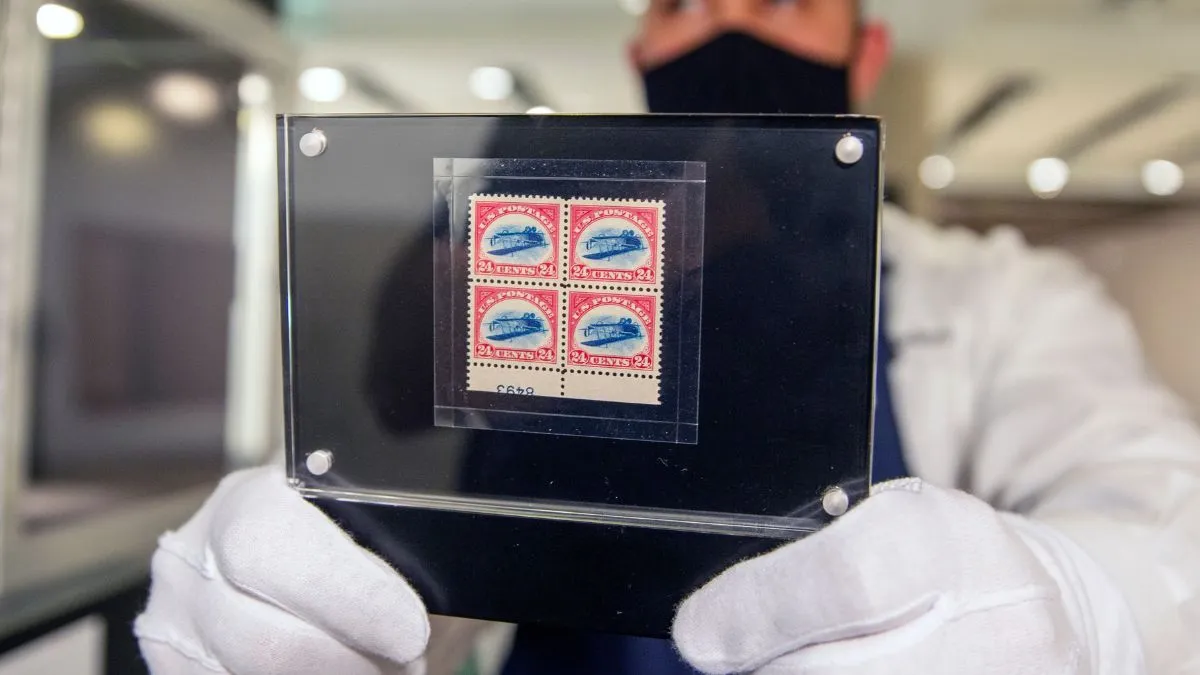
A Washington Clerk Paid $24 for 100 New Airmail Stamps in 1918 and Realized Every Airplane on the Sheet Was Upside Down — No Other Misprinted Sheet Ever Reached the Public, and One of Those 24-Cent Stamps Later Sold for $2 Million
In the world of collectibles, few stories are as remarkable as that of the Inverted Jenny, a postage stamp that transformed a simple printing mistake into one of the most valuable treasures in American history.
Imagine spending just $24 at a post office and discovering that your purchase would eventually become worth millions of dollars. That is exactly what happened in Washington, D.C., in May 1918 when a sharp-eyed stamp collector noticed something unusual about a newly released sheet of airmail stamps. The airplane printed on every stamp was upside down. What seemed like a small manufacturing error would become one of the most famous mistakes ever made by the U.S. government.
More than a century later, a single stamp from that sheet sold for over $2 million, cementing the Inverted Jenny’s place as one of the most valuable and sought-after stamps in the world.
The Birth of America’s First Airmail Stamp
In 1918, aviation was still in its infancy. The United States Post Office was preparing to launch one of the nation’s first regularly scheduled airmail services connecting Washington, Philadelphia, and New York. To celebrate this historic event, officials commissioned a special 24-cent airmail stamp featuring the Curtiss JN-4 “Jenny” airplane.
The stamp was produced using a two-color printing process. A red frame was printed first, followed by a blue image of the airplane in the center. This method required the paper sheet to pass through the printing press twice, creating the possibility of alignment errors.
No one expected that one sheet would accidentally be fed into the press incorrectly, causing the airplane image to appear upside down.
That single mistake would make history.
William T. Robey’s Incredible Discovery
On May 14, 1918, a Washington stockbroker’s clerk and stamp collector named William T. Robey visited a local post office to purchase some of the new airmail stamps. Robey had withdrawn money from his savings account specifically to buy a full sheet of 100 stamps.
When the postal clerk handed him the sheet, Robey immediately noticed something extraordinary.
The Curtiss Jenny airplane printed in the center of every stamp was upside down.
Robey later recalled that his “heart stood still” when he saw the error. Understanding that he had stumbled upon something potentially valuable, he calmly paid the face value of $24 and asked whether any additional sheets were available. The clerk produced more sheets, but those were printed correctly.
Robey had just purchased what would become the most famous stamp error in American history.
Why Only One Sheet Survived
The rarity of the Inverted Jenny is what makes it so valuable.
Postal officials quickly discovered the printing error and immediately began searching for additional misprinted sheets. Investigations later revealed that several other defective sheets had been identified and destroyed before they could reach the public. Robey’s purchase was the only known sheet of 100 stamps that escaped into circulation.
Because only one sheet survived, every genuine Inverted Jenny stamp in existence today can be traced back to Robey’s original purchase. There are only 100 authentic examples, making them among the rarest U.S. stamps ever produced.
For collectors, that level of rarity is the equivalent of finding a winning lottery ticket hidden in plain sight.
From $24 to a Fortune
Robey quickly realized the value of his discovery.
Within days, he sold the sheet to stamp dealer Eugene Klein for $15,000, a massive profit compared to the original $24 purchase price. Klein then sold the sheet to wealthy collector Colonel Edward H. R. Green for $20,000.
Green instructed that the sheet be separated into individual stamps and small blocks, allowing collectors to purchase pieces of the legendary printing error.
As the decades passed, demand for the Inverted Jenny only increased. Stamp collectors, museums, investors, and historians competed for the opportunity to own one of the surviving examples. Each sale pushed prices higher and higher.
The Stamp That Reached $2 Million
In November 2023, one of the surviving Inverted Jenny stamps achieved a new milestone when it sold at auction for more than $2 million. The sale highlighted just how desirable the stamp remains over 100 years after its creation.
Collectors often describe the Inverted Jenny as the “Holy Grail” of stamp collecting because it combines all the characteristics that create extraordinary value:
- Extreme rarity
- Historical significance
- A famous printing error
- Strong collector demand
- A well-documented ownership history
Very few collectibles possess all of these qualities at the same time.
Why the Inverted Jenny Still Fascinates Collectors
The story of the Inverted Jenny is about more than money.
It represents the excitement of discovery, the importance of paying attention to details, and the unpredictable ways in which history can unfold. A simple production mistake turned an ordinary postage stamp into a cultural icon recognized around the world.
Even people who know little about stamp collecting often recognize the image of the upside-down airplane. The Inverted Jenny has appeared in books, museums, television shows, and countless articles discussing valuable collectibles. Its fame extends far beyond the world of philately.
A $24 Purchase That Changed Collecting History
More than a century after William T. Robey walked into a Washington post office, the Inverted Jenny remains one of the most celebrated collectibles ever created.
What began as a routine purchase of 100 airmail stamps became a legendary story of luck, timing, and attention to detail. The sheet cost just $24 in 1918, yet one of its stamps eventually sold for over $2 million.